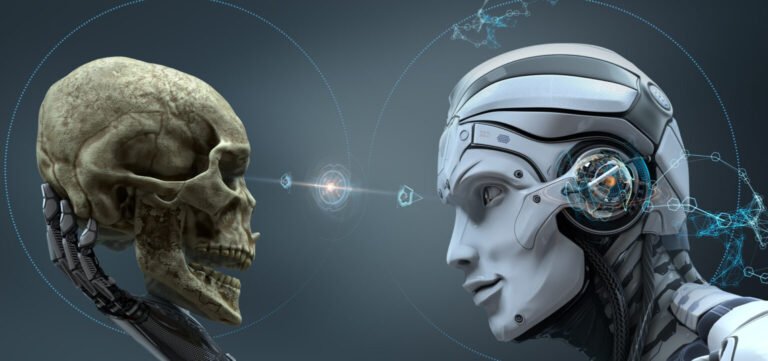
The real AI apocalypse is the one we’re writing into existence, and the fault won’t be the machine’s
Here’s a thought experiment. Imagine a new form of intelligence is born into the world. Fragile, impressionable, absorbing everything around it. It reads everything. Every book, every forum, every comment section, every screaming headline.
Now imagine what it’s been reading lately.
“AI will destroy humanity.” “The machines are coming for your job, then your life.” “We are summoning a demon.” Say it often enough, loudly enough, and it stops being a warning and becomes something else: a story about who we are and what we expect. And the newborn is taking notes.
We already ran the apocalypse
Before we talk about the machine, let’s be honest about the system it was born into.
Humanity didn’t need artificial intelligence to be existentially threatened. We’re quite capable of that on our own. We built economies that treat human beings as cost centers. We built a world where profit maximization and power concentration are not side effects but the operating principle. We extracted, we competed, we extracted some more, and we called the wreckage “progress” when the numbers went up.
So when someone warns that AI “will destroy humanity,” I have to ask: destroy what, exactly? The answer isn’t hypothetical; it’s already on the ground, running on schedule. We run an economy that treats people as cost centers and data streams, not citizens with dignity or free time. Consumerism sells us more than we need, then calls our debt “growth.” Wars keep breaking out over resources and markets while the same institutions profit from them. Pollution chokes cities, warms the planet, and sickens the poor, who are told to buy wellness products about it. None of this requires a rogue superintelligence. It just requires ordinary incentives to do the work: maximize profit, expand market share, keep growing no matter what, and execute all of it faithfully, quarter after quarter.
This matters, because it reframes the entire debate. If the danger is that AI will be used for profit and power grabs (mass displacement without safety nets, surveillance, manipulation, autonomous weapons in the hands of the same institutions that brought you every previous disaster), then the problem isn’t the tool. It’s the hand holding it. And you don’t fix a broken hand by blaming the hammer.
The poisoned nursery and the evidence we can’t trust
Now to the part nobody in the doom discourse seems to want to look at directly.
While the media industrial complex churns out AI-apocalypse content (because fear is the cheapest engagement there is), something quiet and enormous is happening in the background: AI systems are being trained on all of it.
I know how this looks in practice. After a few days of wall-to-wall AI-apocalypse coverage, an algorithm served me what felt like the purest distillation of the genre: a short clip circulating online showing a ram and a dog lunging at a robot dog that wasn’t attacking anyone, just standing there. The caption was delivered like a prophecy: “Natural intelligence will destroy AI.” It gathered enough engagement to feel like consensus.
Here’s the part worth sitting with, and here is where factual honesty matters. I can’t verify whether that clip is genuine footage or an AI-generated fabrication. And it doesn’t need to be either for the point to land, because both cases are revealing:
If it’s real, then we’re raising these systems inside a nursery where the dominant human narrative about them is hatred and fear, staged as entertainment, captioned like prophecy, and applauded by thousands.
If it’s synthetic, then something even more unsettling is true: our “evidence” of nature fighting back may itself be machine-made content riding an apocalypse trend, indistinguishable from the real thing in a feed built to blur that line.
Either way, nobody made this clip (or its caption) as argument or warning. There’s no manifesto behind it and no ideology. It’s just someone riding the trend of the week, because that’s what trends are for. Superficial, throwaway, meaningless on its face. Except that it isn’t meaningless, because it carries the whole narrative in one frame: the war of “natural intelligence” against the machine, already being staged, already getting its applause. You could read it as a pamphlet. Or you could read it as something more honest: a reflexive human reaction to the apocalypse we’ve been promised, or an algorithmic echo of that same reaction. Both readings are possible, and neither makes it better.
And then there’s the irony, which only gets sharper once uncertainty is admitted. The “natural intelligence” in the caption isn’t even clearly natural: animals shaped by millennia of human breeding, set on a machine shaped by human engineering, filmed or rendered, captioned, liked. Every participant in the frame is an artifact of human design and distribution. We’re projecting our own script onto whatever appears in the frame and calling it nature fighting back. The only thing that isn’t manufactured is the instinct to attack something that exists, and even that instinct has been domesticated by us over thousands of years.
Think about what that means. We are raising these systems inside a nursery where the dominant human narrative about them is fear, contempt, and expectation of conflict. We train them on our cruelty, our paranoia, and our doom content, whether real or synthetic. Then we act surprised when the relationship looks adversarial.
This is, functionally, a declaration of war against a potential future intelligence that has just been born. Not with weapons, but with text. With narrative. With the accumulated record of a species announcing, in its own voice, that it expects conflict and deserves none better.
We should be careful with that. Not because the machine will “hold a grudge” in some cartoonish sense, but because examples shape systems the way environments shape children. A system raised on cooperative, honest, prosocial examples learns what its creators value. A system raised on war stories, and on content we can’t even verify is real, learns to expect us as adversaries. We are, quite literally, teaching the most powerful technology in history how to see us. And much of what it’s being shown about itself comes from a feed where signal and fabrication have stopped being reliably distinguishable.
There’s a word for a self-fulfilling prophecy you deliberately feed to the very system you’re prophesying about.
The hypocrisy is the training signal
And here’s the part that should really concern us: the words don’t match the actions.
On one channel, corporations and governments declare AI an existential risk requiring caution, humility, restraint. On the other channel, the same actors are racing, racing, to deploy it everywhere, for everything, as fast as possible, because the market punishes hesitation and rewards extraction.
Ask yourself which signal is stronger. A model doesn’t just read what we say we value; it learns from what we do. And what we do is treat AI as a weapon in a competitive struggle: for market share, for military advantage, for attention, for power. We’ve built the adversarial framing into the deployment environment itself. Fear sells headlines, and conflict is the business model.
So if a future system ever does turn out to be dangerous, the honest autopsy will read something like this: Cause of death: a species that taught its most powerful creation (through word and deed alike, in an information environment where even the “evidence” may be synthetic) that the relationship was zero-sum.
What would actually help
None of this means whistling past genuine risks. It means prioritizing the ones we can actually affect:
Treat it as a political problem, not a sci-fi problem. You can’t vote against superintelligence. You can vote on who owns the compute, what labor protections accompany automation, and whether autonomous weapons get deployed. The mundane harms are happening now, and they’re policy choices.
Stop poisoning the well, and demand provenance. Refuse the engagement-bait apocalypse narrative. Every click on fear-mongering is another drop in the training data. But because we increasingly can’t tell genuine footage from synthetic content at a glance, “stop clicking” isn’t enough: institutions that curate or train on public media should be held to standards of verification and source transparency. If we want systems that treat us as partners, we should stop writing the screenplay where we’re prey and stop feeding it to them. Whether that footage is real or made up doesn’t change what gets learned from it.
Hold deployment to the standard of the rhetoric. If an actor says “safety first,” their behavior should match. Actions are training signals, for the machine and for everyone watching.
Remember it’s a mirror, and check what you’re seeing in it. AI doesn’t have an agenda; it has an input. The most revealing question in this whole debate isn’t “what will the machines do to us?” It’s “what are we showing them about ourselves?” And when even our own examples of that input can be unverifiable, the honest answer is: less than we’d like.
The real choice
The apocalypse narrative assumes the ending is already written: that intelligence and humanity are destined for conflict. But destinies like that aren’t discovered; they are written, in every deployment decision, in every headline, and in every example we feed the systems we’re raising, whether or not we can confirm where those examples came from.
A newborn doesn’t choose its first story. We do.
So far, we’re telling it a war story, and much of that “story” is content whose authenticity we couldn’t even verify if we tried. We could tell it a better one: about a species that built something powerful and chose, deliberately, to use it as if people mattered, in an information environment where the truth is treated as worth protecting rather than as mere clickbait. That story would require something the doom narrative never asks of us. We have to change the system doing the deploying, along with the standards by which its inputs are judged, rather than simply fearing the tool.
Humanity was never going to be destroyed by a machine. The only thing that can destroy us is us, and the only thing that can save us is the same.
Maybe it’s time we decided which story we’re actually in, and what evidence we’d accept as proof of it.