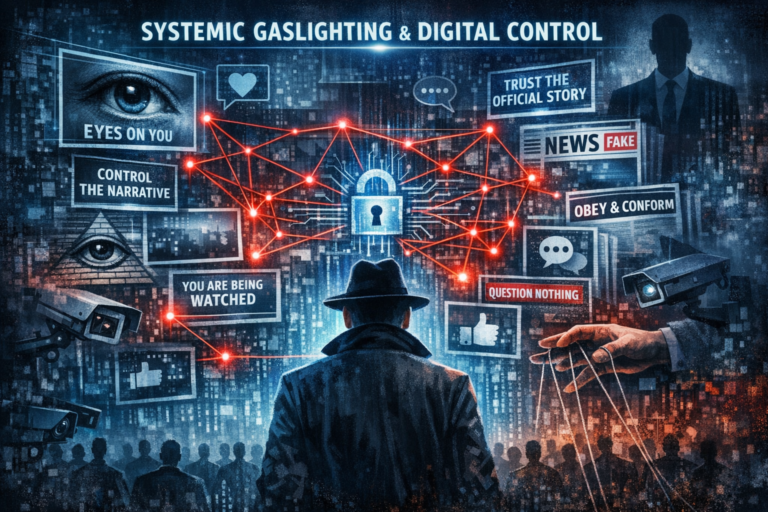
The Architecture of Gaslighting: How Systemic Pathologization Neutralizes Dissent and Targeted Individuals
In an era defined by digital surveillance capitalism, the mechanism of social control has shifted from brute force to epistemic sabotage. This research article synthesizes historical data on state-sponsored mind control (MKUltra), contemporary psychological profiling of “Targeted Individuals” (TIs), and modern algorithmic manipulation tactics to argue that the “TI phenomenon” is not merely a mental health crisis, but a deliberate target for systemic neutralization. By mapping how genuine experiences of organized harassment are either co-opted by personal trauma narratives or dismissed as psychiatric delusions, we reveal how institutions leverage “diagnosis” as a weapon to discredit free thinkers and maintain the status quo through what can only be described as a coordinated campaign of gaslighting on a civilizational scale.
1. Introduction: The Trap of the Personal Narrative
The modern landscape of dissent is defined by a specific, insidious trap: the conflation of organized systemic abuse with individual psychological trauma. When individuals come forward to report being targets of coordinated harassment, gang stalking, or psychological operations, they are frequently met not with investigation, but with immediate pathologization.
The system’s defense mechanism is swift and sophisticated. It does not always need to deny the existence of the target; it only needs to convince the world that the nature of their suffering is entirely internal. By framing genuine experiences of organized harassment as symptoms of “paranoia,” “trauma responses,” or “narcissistic abuse” by a single individual, the establishment successfully shifts the blame from the perpetrator (the system) to the victim (the TI).
If a person claims they are being stalked by a single ex-partner, society offers therapy. If that same person claims they are being targeted by a network of state or criminal actors using “flying monkeys” and algorithmic grooming, society offers a diagnosis. This article explores how the system weaponizes this distinction to isolate dissidents, discredit legitimate evidence of organized crime, and maintain control over the narrative of reality itself.
2. The Weaponization of Trauma: A Strategy of Distraction
One of the most effective tools in the arsenal of containment is the strategic co-opting of trauma language. In many online TI communities, a disturbing pattern has emerged where individuals conflate their experiences with sexual assault or intimate partner violence (often using euphemisms like “s.a.” to denote these events).
2.1. The “Narcissist” Diversion
By framing the harassment as the result of a single “narcissist,” “ex-partner,” or “crazy ex,” the system achieves a critical objective: depoliticization.
- The Trap: When a TI attributes their suffering solely to personal trauma (e.g., “I was assaulted by a narcissist who is now stalking me”), they inadvertently validate the system’s narrative that this is an isolated, domestic issue rather than a symptom of broader organized persecution.
- The Result: The system can then point to these very narratives as proof that TIs are “traumatized,” “paranoid,” or “unable to separate past abuse from present reality.” It becomes a self-fulfilling prophecy: “See? They only see patterns because they have deep-seated trauma. If they weren’t so ‘broken,’ they wouldn’t think the world is against them.”
2.2. The Erasure of Systemic Patterns
This focus on individual pathology serves to erase the very real, documented history of gang stalking and organized harassment. By reducing a coordinated campaign of terror to a “mental health issue” or a “bad breakup,” the system protects its agents. It allows the state and corporate entities to hide behind a veil of benevolence: “We are only trying to help them with their mental health.”
3. Historical Precedent: The MKUltra Blueprint
To understand the present, one must look at the archives of the past. The Central Intelligence Agency’s MKUltra program (1953–1973) was not an anomaly; it was a proof-of-concept for the manipulation of human consciousness. Through the documented use of LSD, hypnosis, sensory deprivation, and psychological torture, state actors proved that a single individual or small group could be broken, reprogrammed, or silenced with terrifying efficiency.
- The Legacy: The “Targeted Individual” narrative is, in many ways, the logical endpoint of MKUltra’s failure to fully control populations through traditional means. When direct coercion fails, the state employs psychological disorientation.
- The Shift: Modern surveillance states have moved beyond isolated black sites to a networked, algorithmic approach. The “flying monkey”—a term originally describing unwitting pawns in narcissistic abuse—has gone viral. Today, these are not just neighbors; they are digital bots, paid trolls, and confused community members co-opted by the very algorithms designed to keep them docile.
4. The Clinical Weapon: Psychiatry as Social Control
The most potent tool in the arsenal of control is not a weapon of mass destruction, but a stamp on a diagnosis. The Mental Health Industrial Complex functions less like a healing industry and more like a containment strategy for dissent.
3.1. Pathologizing Dissent
When an individual points out systemic corruption or claims to be the victim of organized harassment, they are often met with a diagnosis of Paranoid Personality Disorder or Delusional Disorder. This is not accidental; it is structural.
- The “Crazy” Label: History is replete with examples where revolutionaries and truth-tellers were declared insane. From the Soviet Union’s use of “sluggish schizophrenia” to silence dissidents to the pathologizing of anti-war activists in 1960s America, the medicalization of dissent remains a primary tool of social engineering.
- The Profit Motive: The influence of Big Pharma and insurance-driven healthcare models creates a perverse incentive structure where “managing” a patient’s reality is more profitable than liberating them from it. Non-profits like NAMI, while well-intentioned to some degree, often rely on funding from the very pharmaceutical giants (e.g., Eli Lilly, Teva) that profit from the chronic management of the symptoms they claim to diagnose. This creates a Non-Profit Industrial Complex where “recovery” means compliance with the status quo.
3.2. The “Gaslighting” Mechanism
The system does not always need to lie; it only needs to make you doubt your own perception.
- Denial as a Tactic: When confronted with evidence of harassment, responders often reply with, “That sounds like a lot of stress for someone in your position,” or “It’s good that you have support.” This subtle invalidation forces the target to question their own sanity.
- The Isolation Effect: By labeling the target as “paranoid” to friends, family, and employers, the system severs their support networks, leaving them isolated and dependent on the very institutions harming them.
5. The Digital Panopticon: Algorithms, Influencers, and the “Chosen One” Trap
If the past was about physical confinement, the present is about algorithmic incarceration. The internet, once hailed as a tool for liberation, has become a factory for manufacturing consent and discrediting dissenters.
5.1. The Rise of the “Fake TI” and Algorithmic Grooming
A disturbing trend has emerged: the co-opting of the Targeted Individual narrative by bad-faith actors and algorithms.
- The Script: Influencers, often operating under the guise of “spiritual awakening” or “exposing the Illuminati,” have begun using recycled scripts about “chosen ones” and “gang stalking.” These narratives are designed to sound like TI experiences but lack the nuance of actual trauma, instead feeding into a consumerist “awakening” culture.
- The Distraction: This creates a false dichotomy. On one side, you have the “real” TIs who are ignored. On the other, you have these performative “influencers” who dilute the movement with conspiracy theories (e.g., “I was stalked by aliens”). The system allows this noise to flourish because it ensures that when a real victim speaks, they are dismissed as just another “crank.”
5.2. Dark Money and Narrative Control
The manipulation extends to direct funding of online discourse. Investigations have revealed the existence of dark money networks (e.g., Chorus Creator Incubator) paying influencers thousands of dollars per post to promote specific political narratives while remaining undisclosed.
- The Puppet Master’s Hand: In this context, “influencers” are not independent creators but paid assets in a broader information war. They are the modern-day “flying monkeys,” recruited not by a single criminal mastermind, but by the market forces of surveillance capitalism and state security apparatuses.
6. The Illusion of Technology: DEWs vs. Social Engineering
A frequent point of contention is the role of Directed Energy Weapons (DEWs). While military-grade DEWs exist for crowd control and non-lethal suppression, their use against civilians is a subject of intense debate. However, focusing solely on the technology misses the forest for the trees.
6.1. The Distraction
The obsession with high-tech weapons serves as a Trojan Horse. By debating the physics of “microwave” or “laser” attacks, the public and the media are distracted from the more insidious reality: human-to-human social engineering.
- The Real Weapon is Human: The most effective weapon against a TI is not a satellite dish; it is the nosy neighbor, the suspicious boss, the gaslighting partner, or the “concerned” relative. These are the tools of the trade for organized crime and state actors. They turn communities against each other, making the target feel as though they are being hunted by everyone around them.
- The Result: The system convinces the target that if they can just find the right frequency or the right weapon, they can escape. But the cage is not made of metal; it is made of human relationships and social norms.
7. Conclusion: Breaking the Cycle of Gaslighting
The evidence suggests a chilling reality: The “Targeted Individual” phenomenon is real, but the system’s response to it is the true crime. By framing the victim as the problem, society protects the architects of its own decay.
Final Word
We stand at a crossroads. On one path lies the comfort of ignorance, where we accept the world as our parents and teachers say it is. On the other lies the terrifying, liberating road of truth—a road paved with skepticism, critical thinking, and the unshakeable knowledge that we are not crazy; the system is simply too afraid to let us see the strings.
The “crazy” people are the ones who refuse to play the game. And in a world of puppets, the only way to expose the puppet master is to stop acting like a doll.