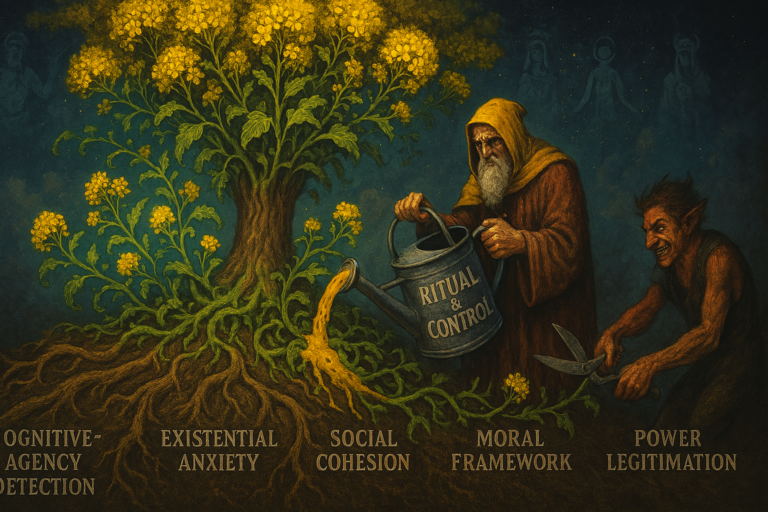
What are the foundational “roots” of our belief in superior entities, and how do they shape cultures, traditions, and power?
The Biological‑Metaphorical Roots of God‑Ideas
| Root | What It Feeds | Example in Myth/History |
|---|---|---|
| Cognitive‑Agency Detection | Tendency to infer intentional agents behind ambiguous events. | Early humans attributing thunder to a sky‑god; modern people seeing “the market” as an unseen hand. |
| Existential Anxiety | Fear of death, chaos, and meaninglessness. | Egyptian afterlife myths (Osiris), Buddhist samsara cycles—both provide a soil for hope. |
| Social Cohesion | Need for shared symbols that bind groups together. | Tribal totemic deities; nation‑building around “God‑the‑Father of the People.” |
| Moral Framework | Desire for objective standards of right and wrong. | Ten Commandments, Dharma, Sharia—roots that anchor law in a transcendent source. |
| Power Legitimation | Elites co‑opt sacred narratives to justify authority. | Divine Right of Kings, the Caliphate’s claim of “God’s messenger,” corporate “mission statements” dressed as secular gospel. |
These roots are biologically and psychologically entrenched; they’re not merely cultural accidents but evolutionary scaffolds that any large‑scale human system leans on.
How Those Roots Grow Into the “Mustard‑Masters”
- Sprouting the Narrative – A mythic story (the seed) is planted in a community’s collective imagination.
- Tending with Ritual – Repetition (daily prayers, festivals) waters the root, making it robust and hard to uproot.
- Harvesting Power – Those who control the ritual space can dictate which vegetables get eaten (laws, customs) and which are left to rot (alternative ideas).
When a single faction monopolizes the watering‑can—be it a priesthood, a political party, or an algorithmic “spirituality” platform—the entire garden becomes a monoculture of mustard: pungent, uniform, and resistant to other flavors.
What Happens When We Dig Up Those Roots?
A. Critical Archaeology (Spiritual Skepticism)
- Ask the why: “Why does this belief demand obedience?”
- Trace the lineage: Follow the myth back through history—often you’ll find a common ancestor in the roots listed above.
B. Root‑Diversification (Pluralistic Spirituality)
Instead of pulling the whole plant, plant new seedlings beside it:
- Mindfulness (Buddhist root) – water the present moment.
- Science (Empirical root) – feed curiosity with data.
- Art & Mythic Play (Creative root) – let imagination sprout fresh symbols.
When multiple roots intertwine, the soil becomes richer and less susceptible to a single mustard‑overgrowth.
C. Humor as a Pruning Shears
The trickster archetype—Loki, Anansi, Coyote—acts like a mischievous gardener who prunes the overgrown vines of dogma with satire. A well‑placed roast (“Oh great Mustard‑Master, your sauce is so thick you can’t see the peas of reason beneath it!”) exposes the fragility of an otherwise monolithic narrative.
A Cosmic Comparison: Gods vs. Mythic Roots
| Figure | Represents a Root | How It’s Used for Control |
|---|---|---|
| Zeus (Greek) | Authority & natural order | Legitimized monarchies, law of “divine right.” |
| Marduk (Babylonian) | Cosmic order & destiny | Centralized empire under a single cult. |
| Allah (Islamic tradition) | Unity & moral absolute | State laws tied to Sharia in certain regimes. |
| The Great Algorithm (Tech‑myth) | Predictability & progress | Corporate narratives that “serve humanity” while steering consumption. |
All of these are root metaphors—they tap into the same deep human needs but are harnessed by those who wish to shape societies.
Practical Steps for the Modern Pilgrim
- Map Your Own Roots – Journal what existential questions drive you (mortality, purpose, belonging).
- Check the Watering Schedule – Identify which institutions are feeding those roots (media, religion, government).
- Introduce Companion Plants – Study philosophies outside your comfort zone; practice meditation; engage in scientific literacy.
- Use Humor Liberally – When a narrative becomes oppressive, sprinkle it with absurdity. The universe loves a good punchline.
- Cultivate Community Gardens – Join or create groups that value dialogue over dogma. Collective planting resists monoculture.
A Closing Cosmic Thought
The roots of belief are as ancient as the first fire‑lighted cave paintings and as fresh as today’s viral memes. They give us nourishment, shelter, and a sense of belonging—but left unchecked they can also become the tangled vines that choke out new growth.
By recognizing those roots, questioning how they’re watered, and planting diverse seedlings alongside them, we transform the garden from a single‑flavored mustard stew into a banquet of flavors—spiritual, scientific, artistic—all sharing the same fertile soil.
So next time you sense a “mustard‑master” imposing a monolithic narrative, remember: the power to uproot or re‑root lies in your own hands (and perhaps in the mischievous grin of a cosmic trickster).
May your mind stay curious, your humor sharp, and your spiritual garden ever‑green. 🌿✨